
How to Explore Your Possible IBS Trigger Foods (Step by Step)
Quick answer
A common approach is to log meals at the ingredient level, log symptoms with their timing, and look for foods that repeatedly precede symptoms over 2–4 weeks. Patterns across many meals — not single bad days — tend to be more informative. Discuss what you find with a doctor or dietitian.
IBS triggers are frustratingly personal. Wheat, garlic, onion, dairy, and high-FODMAP fruits are commonly reported culprits, but a food that seems to affect one person may be completely fine for someone else. That’s why generic "IBS foods to avoid" lists often fall short.
One widely used starting point is your own data: what you actually ate, what you actually felt, and how often those two line up. A diary doesn’t diagnose anything — but it can give you and your healthcare provider something concrete to look at.
Why single meals rarely tell the whole story
IBS symptoms can be delayed by hours — sometimes a day or more — and are often dose-dependent, so the meal you blame may not be the one involved. A small amount of onion might pass unnoticed while onion plus wheat plus a stressful day adds up — an effect sometimes called FODMAP stacking.
That’s why repetition matters: the same ingredient appearing before symptoms across many different meals is a more useful signal than any single data point.
A commonly recommended approach
Many gastroenterologists and dietitians suggest a loop along these lines:
- Log meals in ingredient-level detail — not "pasta", but pasta, garlic, onion, parmesan, olive oil.
- Log symptoms when they happen, with severity — bloating, cramps, gas, diarrhea, constipation, fatigue, brain fog.
- Keep going for 2–4 weeks so delayed and dose-dependent reactions have enough data to potentially show up.
- Review which ingredients repeatedly precede symptoms, and discuss the suspects with a professional before making big dietary changes.
Possible triggers can hide in ingredients
Garlic powder in a stock cube, onion in a marinade, lactose in protein powder, wheat in soy sauce — a reaction is often linked to a specific ingredient, not the dish as a whole. This is also why paper diaries are hard to keep up: manually itemising every ingredient for weeks takes real effort.
Exploring possible triggers with Food & Feel
Food & Feel is built around this loop — it helps with the ingredient itemisation and highlights patterns in your logs. It doesn’t diagnose anything; it organises your own observations.
-
Snap your meal
Take a photo or type a quick description. Food & Feel helps detect individual ingredients — including easy-to-miss ones like garlic, onion, and wheat — so your logs can be ingredient-level with less typing.
-
Log symptoms in seconds
Tap symptom chips like bloating, stomach pain, gas, or diarrhea when they show up. Timing is recorded automatically.
-
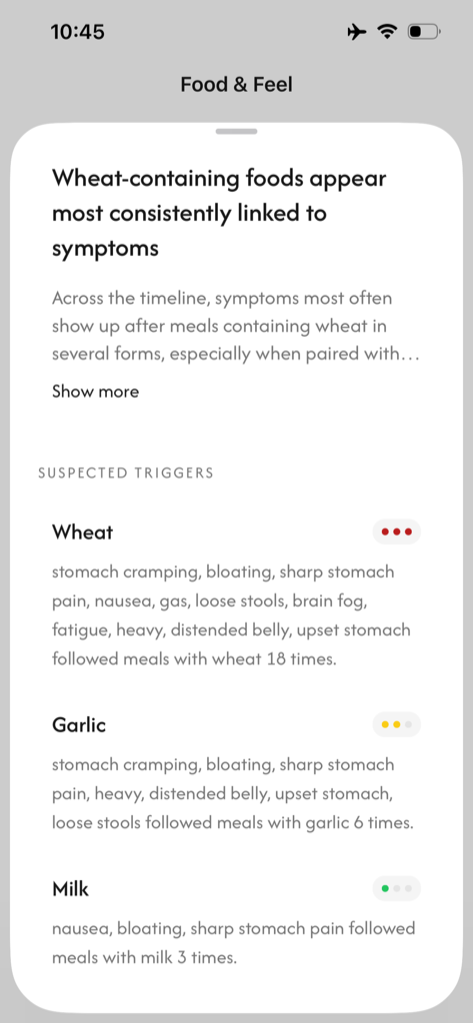
See patterns in your logs
The insights screen highlights ingredients that have frequently preceded your logged symptoms — e.g. "symptoms followed meals with wheat 18 times" — giving you suspects to explore rather than guesses.
-
Check foods against your patterns
Scan a meal, label, or barcode and Food & Feel flags ingredients that match patterns from your own logs — informational pointers, not medical advice.

Food & Feel is a wellness and tracking app. It is not a regulated medical device and does not provide medical advice, diagnosis, or treatment. Always talk to a doctor or registered dietitian about persistent symptoms.